Reference
What Is Medical Billing?
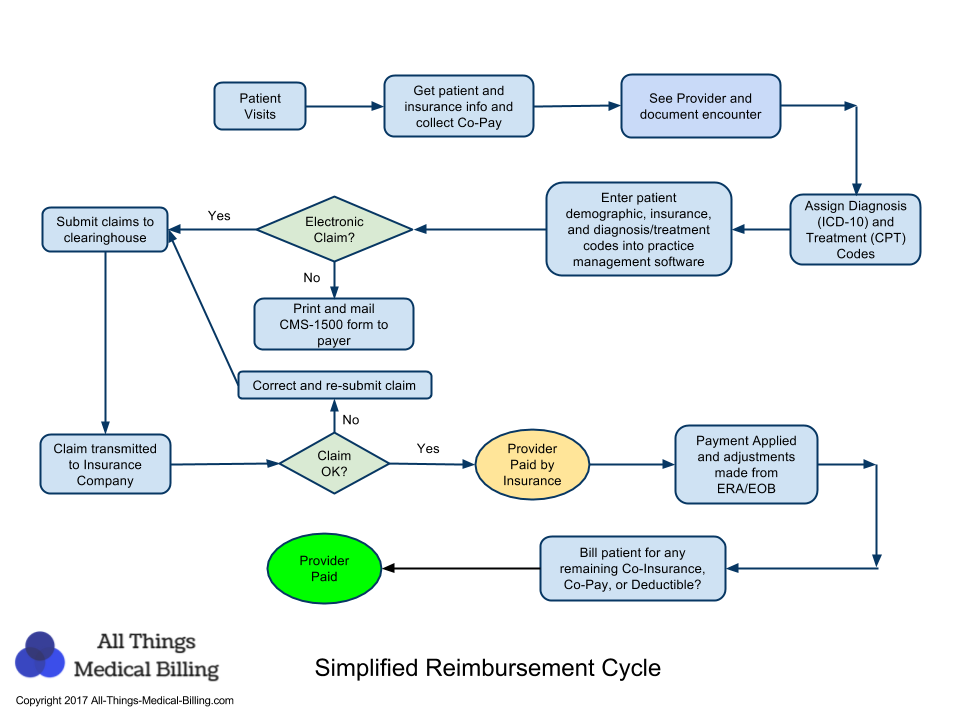
The reimbursement cycle
Claim paid Refused — appeal it
Overview of Medical Billing
Medical Billing is the process of getting a provider paid for their services. This is payment from the insurance carrier and the patient for uncovered or deductible charges.
A good medical billing specialist knows how to get their provider paid promptly for the services they perform.
What the billing specialist does is not easily automated. Much of their task is interpreting physician notes and records, verifying and correcting patient and insurance information, verifying correct coding, etc.
It’s pulling all this critical information together, insuring it is accurate, and assembling it into a claim. That’s just getting the claim filed! It still must go through the insurance payer adjudication process.
Once a claim is processed and paid, applying payments has several other challenges that are not easily automated. Billing specialists frequently must interpret payer coding error messages and correct them or submit additional documentation to get a claim successfully processed.
A Medical Billing Specialist could also be referred to as an Insurance Billing Specialist. That’s because the majority of what a billing specialist does revolves around health insurance. Health insurance can be very complex and frustrating – an it’s always changing!
In a smaller single physician office, the billing specialist may handle everything.
Overview of Medical Coding
Medical billing and medical coding are separate but closely related. Both are critical to getting the health care providers paid.
The medical coder analyzes patient charts and assigns the appropriate alphanumeric and numeric codes. These medical codes are the standard diagnosis and treatment codes used throughout the healthcare industry.
Both coders and billers use medical records as the basis for their work. The difference is the coder used patient medical records determine the appropriate codes for the medical services. The biller uses medical records necessary for payment of these services.
The Reality of Billing & Coding
In an ideal world, once the medical coder has determined and assigned the appropriate codes, it is the medical billers responsibility to use this information to prepare and submit a claim.
When the claims has been successfully paid, the medical biller posts these payments, determine what the patient is responsible for, and reconcile the accounts.
Most smaller practices cannot justify having both a coder and a biller. Since they typically they use many of the same codes over and over, it’s important for the biller have some coding knowledge for the specialty. Periodically have to look up ICD and CPT codes, understand what the modifier means, and recognize when the codes are incorrect.
Situations where you have both a Medical Coder and Medical Biller is typically for larger healthcare providers – multi-physician practices, clinics, hospitals – places that see a lot of patients and have centralized coding and billing.
Jack of All Trades – Typical Medical Billing Tasks
- Create and maintain patient account ledgers.
- Determine patient responsibility based on their particular health insurance plan.
- Look-up medical diagnosis and treatment codes.
- Enter information from patient registration forms and superbills into the practice management software.
- Understand managed care authorization and coverage limits. Communicate with insurance payers to resolve rejected or denied claims.
- Transmit claims to clearinghouse or insurance payer.
- Send patient statements and occasionally answer questions about their bill.
- Run reports on outstanding claims and patient accounts.
- Coordinate delinquent patient accounts with a collection agency.
- Enter insurance and patient payments into the practice management patient ledger
The Payment Process
- Patient sees Physician who evaluates the patient and writes down the observed conditions and treatment. This information is then assigned the appropriate ICD-10 diagnosis and CPT treatment codes (and code modifiers if necessary.
- Diagnosis & Treatment codes are documented on the Superbill. Some physicians will check or circle the diagnosis and treatment codes directly on the superbill. The majority of patient visits involve using a lot of the same codes.
- The medical billing specialist gets involved here. They take the superbill and insurance information and input into the practice management (or medical billing) software. A claim is created from this information. Electronic claims are transmitted or uploaded to either the insurance company or a clearinghouse.
- If there are problems with the claim the medical billing specialist follows up to find out why, correct the claim, and resubmit. An appeal may also need to be written and submitted with supporting information to the insurance company.
- Once payment is received from the insurance carrier, it is accompanied by a Remittance Advice statement. This information is entered into the software. If there is any patient responsibility such as co-pays and co-insurance, a patient statement is printed and mailed.
- Unpaid claims require investigation and follow-up to keep accounts receivables low for the practice. Delinquent patient accounts may require additional statements or letters to collect unpaid balances. If still unpaid these may be turned over to a collections agency.
<< Back To Introduction to Medical Billing Page
Reader questions on this
Billing for telemonitoring
What claim form would a Home Health Agency use to file a claim for telemonitoring?
We haven’t had any experience billing for home health services with regards to telemonitoring. My first thought is the CMS-1500 or CMS-1450 form would be used as it is for in-person services. The form used depending on whether the services are provided by an individual healthcare provider (CMS-1500) or a facility (CMS-1450).
We invite our visitors to share comments or offer an answer using the “Click here to post comments” link below.
Hospital billers and coders
Hospital billers and coders generally think that the purpose of diagnosis coding only billing (describing patient conditions and getting paid) What other aspects of diagnosis coding could affect us on a personal level?
Response:
By personal level I assume you mean how it affects the patient and how the diagnosis code is used for purposes other than billing.
Diagnosis codes are used by the government to track diseases. This is helpful in determining how diseases spread and geographic patterns.
The ICD codes are also documented on death certificates to identify the cause of death for tracking by health officials.
Another benefit to using diagnosis coding – in our case ICD-9-CM – is that it establishes a standard for recording the diagnosis a patient receives. This makes it possible for other medical professionals to know the patients diagnosis and medical history when they go to another provider, hospital, etc.
Everyone uses the same diagnosis coding standard – regardless of location, specialty, etc. This becomes important as electronic health records are used by more providers making it easier to share a patients medical treatment and history.
Sorting the practice's mail
Hello,
I just got a job in a medical billing company. One part of the job is to sort the mail. I have to separate the mail by charges, notes, correspondence, payments and hospital bills. My question is how can you tell the difference between them all? They all look the same to me. Any help would be appreciated.
Great question Jacqueline – I understand the difficulty identifying the differences in all the types of mail coming into a billing office.
The only way I could really sort is by the return address – if there was one – or the type and color of envelope. As you probably know some of the mail doesn’t have much to identify it on the outside. I got better at sorting over time only because I learned what the different types of mail was based on identifiers on the envelope and size, color, etc.
For example patient payments came in a certain size and color envelope so they were easy to sort. Also payments from certain insurance payers were easier to identify. Unfortunately there were always some that I couldn’t identify without opening.
Thanks for your question – Unfortunately I don’t know an easier way other than just experience.
– Gina
Verifying benefits from a web service
I have two friends that are chiropractors. While talking to one of the office managers yesterday, she expressed to me how frustrating it is to verify insurance. They wind up calling every insurance company to verify chiropractic and physical therapy services. Does anyone know of a web-based service for insurance verification that specializes in chiropractic practices?
Thanks.
I know insurance verification – especially for certain specialties – can be a very time consuming and frustrating experience.
Visitors,
Please post a response below by selecting the “click here to add your own comments” if you know of an online insurance verification service for chiropractic and physical therapy.
Thanks!